What Is Ayurveda? A Clear Introduction to the Science of Life
The oldest continuously practised system of medicine, explained without mysticism — what it is, how it thinks about the body, and why it still works as a framework for daily care.
7 min read · Ayurveda Nest editorial team · Updated
The short answer
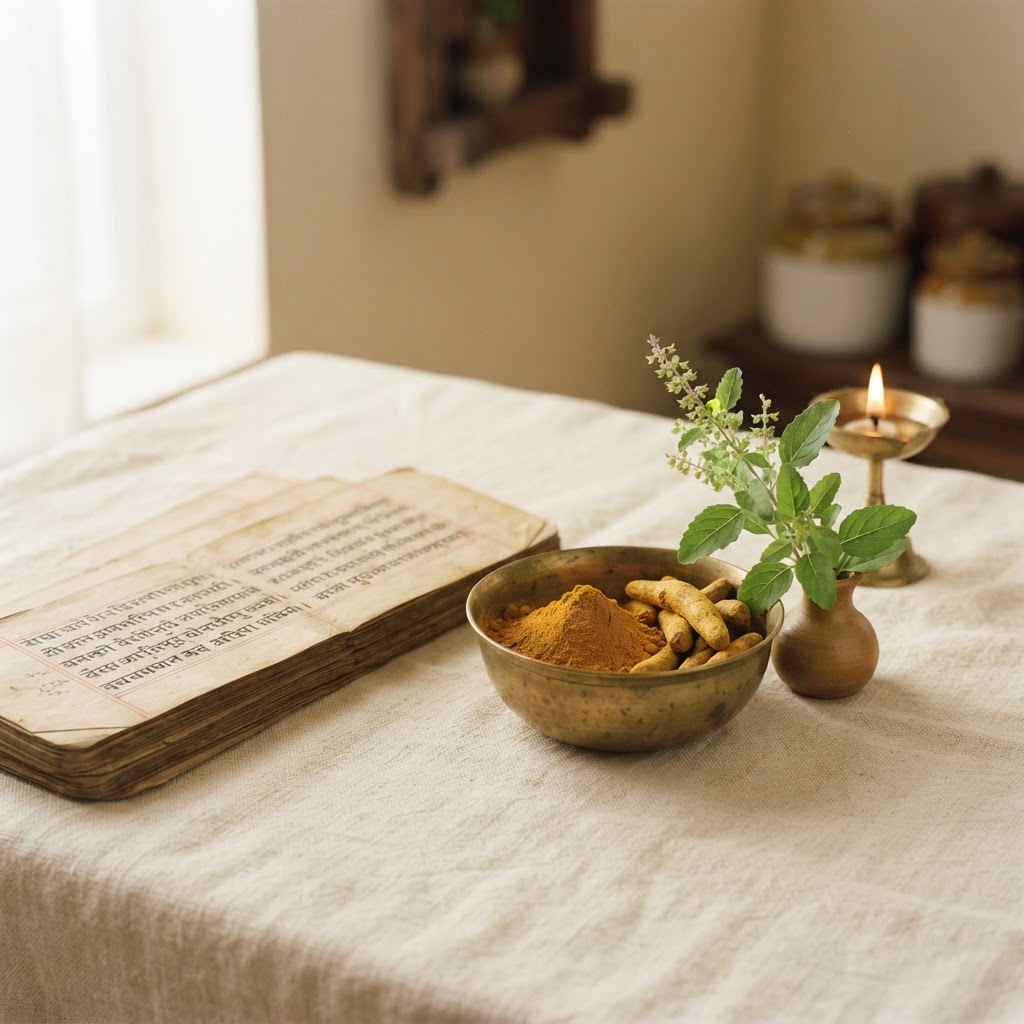
Ayurveda is the traditional medical system of India, recorded in texts such as the Charaka Samhita and Sushruta Samhita more than two thousand years ago. It holds that every person has a unique constitution (prakriti), made of three functional forces called doshas — Vata, Pitta and Kapha — and that health is the state in which those forces, your digestion and your daily rhythm are in balance.
The word itself
Ayurveda comes from two Sanskrit roots: ayus, meaning life, and veda, meaning knowledge. It is usually translated as "the science of life", and the name is accurate about its scope. Ayurveda is not only a set of remedies. It is a complete framework for how a human being eats, sleeps, works, ages and recovers.
Its classical texts describe surgery, pharmacology, paediatrics, psychiatry and rejuvenation. What most people encounter today is the part that concerns everyday living — food, routine, seasonal adjustment and self-care — because that is where Ayurveda is most practical for anyone outside a clinic.
The five elements and the three doshas
Ayurveda describes all matter as combinations of five elements: space, air, fire, water and earth. In the body, these combine into three doshas — functional principles rather than substances.
- Vata (air and space) governs movement: breath, circulation, nerve impulses, elimination and the movement of thought.
- Pitta (fire and water) governs transformation: digestion, metabolism, body temperature, perception and judgment.
- Kapha (earth and water) governs structure and cohesion: tissue, lubrication, immunity, stamina and emotional steadiness.
Constitution and imbalance
Everyone contains all three doshas, but in a personal ratio fixed at conception. That ratio is your prakriti, or constitution. It explains why two people can eat the same meal, keep the same schedule and react completely differently.
Your current state — the ways the doshas have drifted from your baseline through diet, stress, season and age — is called vikriti. Ayurvedic care is always aimed at the gap between the two: bringing the current state back toward the constitution you were born with.
Agni: the centre of Ayurvedic health
If the doshas are the vocabulary of Ayurveda, agni is its grammar. Agni is digestive fire — your capacity to break down food, experience and information. Strong agni produces clear tissue and steady energy. Weak or erratic agni leaves behind ama, an undigested residue that Ayurveda links to heaviness, a coated tongue, fatigue and, over time, disease.
This is why so much Ayurvedic advice is about when and how you eat rather than only what you eat.
Is Ayurveda evidence-based?
Some Ayurvedic practices have a meaningful research base — slow breathing for nervous-system regulation, turmeric and ginger for inflammation and digestion, consistent sleep timing, oil pulling and tongue scraping for oral health. Others rest on classical reasoning that has not been formally studied. A responsible approach treats Ayurveda as a structured framework for lifestyle care, used alongside modern medicine rather than instead of it.
Where to begin
The single most useful first step is to identify your constitution. General Ayurvedic advice is written for everyone at once, and much of it contradicts itself — a warming practice that settles one person inflames another. Once you know your dosha, the advice sorts itself into what applies to you and what does not.
Free assessment
What is your dosha?
General advice only goes so far. The Ayurveda Nest assessment reads your constitution and your current imbalance in about ten minutes — so you know which guidance applies to you.
Take the dosha quizFrequently asked questions
- How old is Ayurveda?
- Its roots are in the Vedic period of India, and its core medical texts — the Charaka Samhita and Sushruta Samhita — were compiled roughly 2,000 years ago, making it one of the oldest continuously practised systems of medicine.
- Is Ayurveda a religion?
- No. Ayurveda grew out of the same culture as Hindu philosophy, but it is a medical and lifestyle system. You do not need any belief to use its dietary and daily-routine guidance.
- Can Ayurveda replace my doctor?
- No. Ayurveda works well as a framework for daily habits and prevention, but diagnosis and treatment of disease should come from a qualified healthcare professional.
- What is the first step in Ayurveda?
- Learning your dosha constitution. It determines which foods, routines and practices are balancing for you specifically.
Keep reading